AI Marketing for B2B SaaS: Scale Pipeline in 2026
How modern B2B SaaS teams are using AI to generate pipeline without adding headcount — with playbooks, metrics, and the mistakes we made along the way.
Shekhar Kumar
Founder, MarkAI
Every B2B SaaS marketing leader is being asked the same question in 2026: "How are you using AI?" The answers are mostly bad. Teams are either spinning up ChatGPT to draft blog posts nobody reads, or they're buying a dozen AI point tools that don't talk to each other.
This is the playbook that actually moved pipeline for us — and for the five SaaS companies we work with closely.
- Pipeline generated
- $4.2M
- Quarters to payback
- 1.8
- Cost per MQL
- -62%
The old funnel is already broken
The old B2B marketing funnel assumed a single, linear buying journey. Awareness → consideration → decision. Each stage had its own channel, its own CTA, its own dashboard.
That model collapsed around 2024. Buyers now do 70% of their research before talking to you, and most of that research happens in channels you can't measure: Slack communities, podcast clips, a friend's DM, an AI summary.
If your team is still optimizing MQL-to-SQL conversion as the north star, you're measuring the wrong surface.
What AI actually changes
Three things, in order of impact:
- Compression of research. Tasks that used to take a researcher a week now take a model 20 minutes.
- Personalization at list scale. A single marketer can ship 500 variant landing pages a quarter.
- Closed-loop attribution. Models can now reconcile self-reported attribution with touch-level data without a dedicated analyst.
Notice what's missing: "writing more content." AI's value is not in replacing writers. It's in removing the bottlenecks that keep writers from doing the thinking.
The four-layer pipeline stack
Here's the stack that's working for the teams we advise:
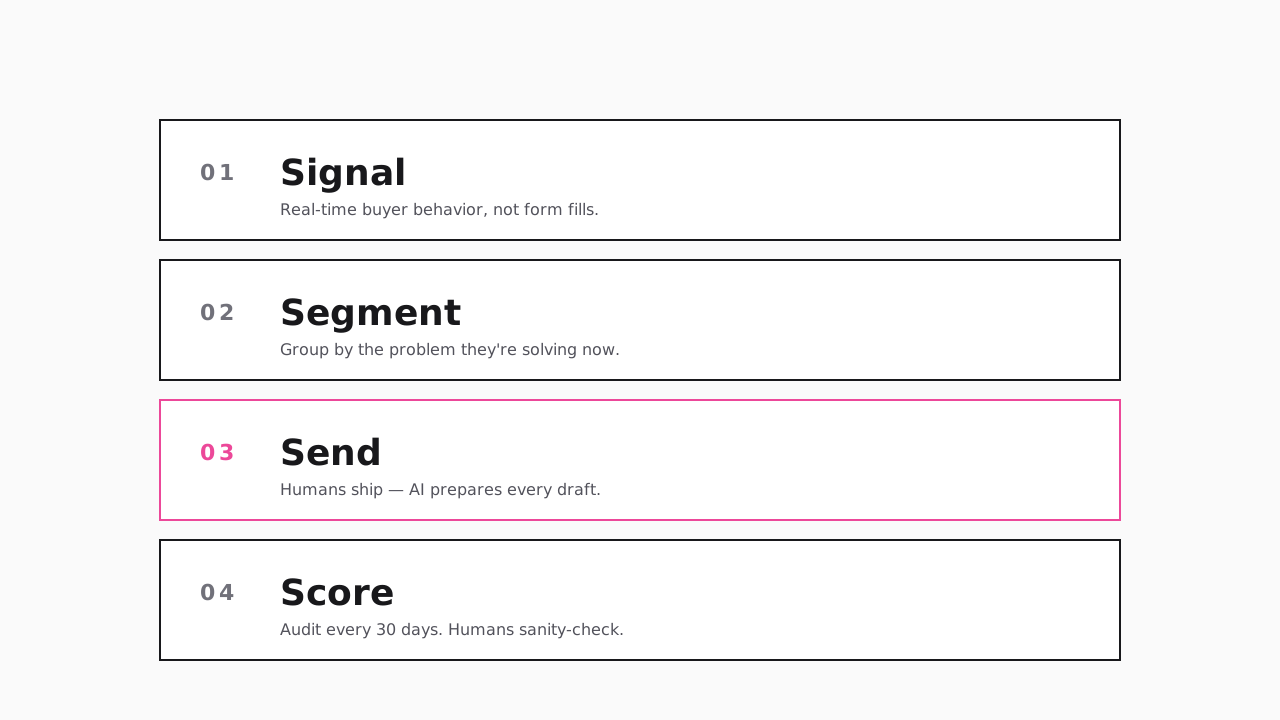
1. Signal
Before you generate anything, you need a real-time view of what your buyers are doing. Not form fills — actual behavior. Job change detection, G2 page visits, funding announcements, tech stack changes.
A model that knows "this prospect just raised a Series B and hired a VP of RevOps" writes a fundamentally different email than one working from a LinkedIn title.
2. Segment
Stop segmenting by persona. Segment by the problem they're currently trying to solve.
Prompt:
Given the following signals about ACME Corp:
  - Funded $40M Series B on 2026-03-12
  - Hired VP RevOps 2026-03-28
  - G2 pageview: Salesforce alternatives
  - Visited our pricing page twice in 14 days

Classify this account into one of:
  - Rebuilding revenue ops
  - Consolidating vendors
  - Greenfield buyer
  - Late-stage evaluator
Feed the output into your sequencing tool. That's the segment.
3. Send
The point of AI in outbound is not to send more emails. It's to send the same volume with radically higher relevance. A 60-person SDR team should be able to collapse to 20 SDRs and hit the same number, because each rep is backed by models that compose the first draft of every touch.
4. Score
Scoring is where most teams quietly lose the plot. They stand up an AI-powered lead score, watch it fire, and never audit it. Six months later they discover it's been weighting a feature that leaked from the label.
The discipline: audit your model every 30 days against manually-reviewed cohorts. If a human rep can't look at the top 10 scored accounts and immediately say "yes, those are the right ones" — the model is wrong.
What we actually built at MarkAI
We started the year with a pipeline gap. We had ~$180K in committed pipeline and needed $1M to close the quarter. Here's what we did:
Week 1–2: Signal layer
We wired Clearbit, Apollo, and our own product telemetry into a single event bus. Every signal flows through a classifier that tags it with "buying-stage-relevance."
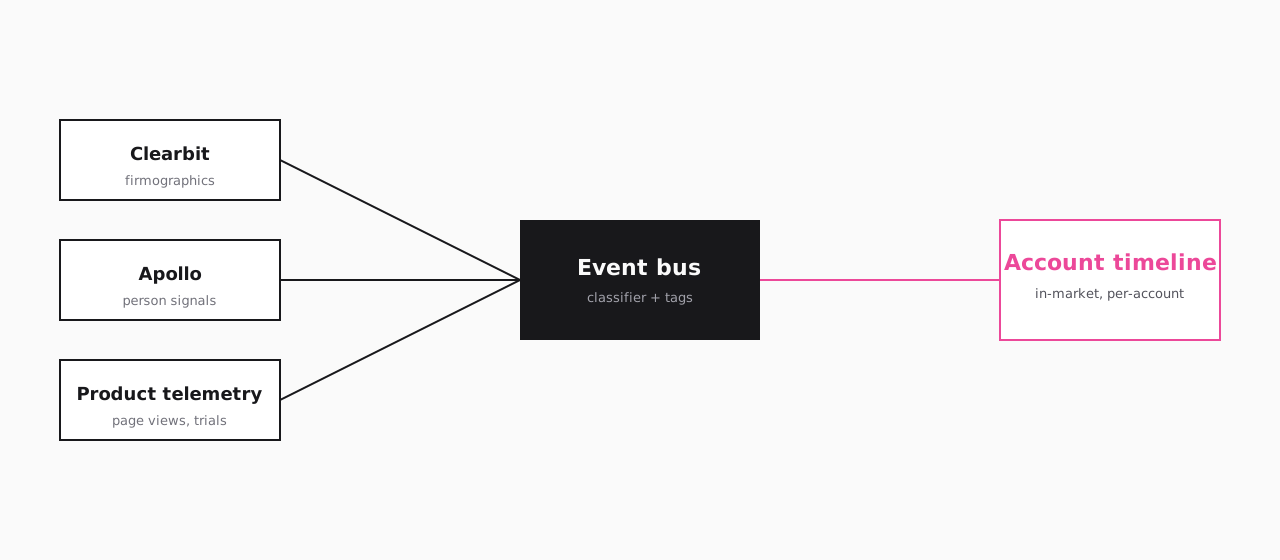
The output: a per-account timeline that shows, at a glance, which accounts are actively "in-market."
Week 3–4: Message library
Instead of writing 300 one-off emails, we wrote 30 frameworks — structural templates with clear slots for the model to fill in.
Framework example:
Subject: {{trigger_event}} at {{company}}

Hey {{first_name}},

Saw that {{trigger_event}}. When teams hit {{stage_descriptor}}, the part that
usually breaks first is {{pain_hypothesis}}.

We help companies like {{lookalike_1}} and {{lookalike_2}} close that gap in
{{timeframe}}.

Worth a 15-min swap?

— Shekhar
Week 5+: Review loop
Every Monday morning, a marketer and an SDR sit down for 30 minutes and review the 25 lowest-performing message variants. Kill the bottom five. Promote the top three to "default." The model re-learns from that feedback weekly.
Anti-patterns we fell into
- "Let's build our own LLM." No. You're a SaaS company, not a research lab. Use a frontier model behind your own prompt layer.
- "Let's score every account automatically." You don't have enough labeled data yet. Start with rules. Graduate to a model at ~500 labeled outcomes.
- "Let's personalize everything." Personalization has a cost — cognitive and latency. Reserve it for the moments that matter: first touch, pricing page, proposal.
The 2026 marketer's job
The role is changing. A growth marketer in 2026 spends:
- 20% of their time writing
- 30% of their time reviewing model output
- 30% of their time analyzing what worked
- 20% of their time talking to customers
The ones who thrive aren't the ones who write the best copy. They're the ones who can diagnose a broken signal → send → score loop faster than anyone else.
That's the job.
Want to pressure-test your own AI marketing stack? Book a 30-min teardown — I'll walk through what's working and what's leaking, no pitch.